
Us
Who is tethered to whom?

This newsletter is free for everyone - enjoy!

Most of us, if faced with a mega-successful, culturally momentous debut like Get Out, would crumble under the pressure of even the idea of a follow-up film. But Jordan Peele prevailed with Us, a deliciously creepy foray into the nightmares we’ve all had at least once, waking or sleeping, of murderous doppelgängers and losing control.
A young girl named Addy wanders off from her parents at the Santa Cruz boardwalk one night and finds herself inside a creepy hall of mirrors called VisionQuest, in which she meets another girl who looks exactly like her. The experience is so frightening she becomes unable to speak even after being found safe and sound, and years later when she returns with her own family to the Santa Cruz area for their annual summer vacation, Addy has strange premonitions that something about that long ago night is coming back to haunt her. (There’s some well-placed imagery of patterns and repeating 1’s and twins that enhance the effect)
She is right: the strange little doppelgänger, now all grown up too, shows up one night with her own lookalike family in tow, along with some seriously large, sharp scissors. Addy’s family is terrorized and hunted by their evil twins, but we find out it is not just their plight—the nice white family we met at the beach are murdered by their own doppelgängers in their vacation home across the lake. In fact, people everywhere are showing up wearing red jumpsuits, carrying scissors, looking crazy, and killing their “real world” counterparts.
Addy’s twin, named but never called Red, explains that they come from a world below—tunnels, actually, where they live “tethered” to their counterparts, living fractious, meaningless existences that merely mimic what is happening upstairs, in the real world. Long ago the government had experimented with creating clones to control the world above, but the project and the people were abandoned at some point, with the cruel outcome that it was the clones who appeared controlled and enslaved. But now they are busting out, under Red’s command, and taking charge of their lives for literally once by disposing of the twins who’ve had it so good for so long.
In the tunnels, everything is bizarre: there are exact replicas of the people of the world upstairs but as they mimic the actions of the world above they do so stiffly, or jerkily, or with false cheer and emotion. They are recreating actions as if pulled by strings; we see the juxtaposition as Red describes this tormented group of people to Addy—a couple above is on a date at the boardwalk, sweetly sharing carnival food, but below their replicas are tearing at the raw flesh and meat of rabbits, the only food remaining in the tunnels for their survival, and their focus is on the gobbling down of food, not each other. While people above swing in the air in a lighted, colorful ride, their replicas downstairs stand huddled together, leaning forward and backward with exaggerated gasps and squeals, their faces masques of contortion without any of the genuine excitement and happiness of their counterparts.
The tunnels are, in short, an abomination—a replication of our world without any of those things which purportedly make us real. And worse, they hold a tragedy. We find out (if we hadn’t already figured it out, ahem) at the end of the film that when Addy met her doppelgänger in the hall of mirrors that long-ago night, she was stolen and replaced by the girl. Addy is Red and Red is Addy, and you’ll have to keep up.
Addy and Red were special, you see—not just leftover government experiments but twin souls to the extent that Addy could sense her counterpart’s presence above. And on the night that Red was closest to her, she escaped the tunnels and met her, then knocked her out, dragged her below, handcuffed her to a bed, changed their clothes, and took her place. So our “Addy” who lived in fear of the boardwalk at the beginning of her summer vacation had every right to do so, as she could not blame her little twin for growing up and trying to take revenge for a life stolen, and lived in the most deranged shadows.
When “Addy” (actually Red) met and fell in love with Gabe, the real Addy was forced to unite with his counterpart Abraham, and bear the same children including one by C-section which, as she points out, meant she had to cut the baby out herself in the tunnels. At one point in the movie Gabe gives his wife a short kiss, and I had to wonder what that would have looked like down in the tunnels, where everything was rote and emotionless—stiff, awkward, unwanted. I had to wonder at the life Addy was forced to lead with Abraham. What did sex upstairs look like downstairs? Rape? What did rape in the real world look like in the tunnels then? You see why I use the word abomination.
And why Addy rose up. She managed to join the others in the tunnels to her will and carry out a plan to rise up against the world upstairs, cut the cord that bound them (through murder, with the symbolic scissors), and then—well, because this is a Jordan Peele movie—stand hand in hand in a giant Hands Across America art installation because that’s what you do to celebrate I guess. (It was a commercial Addy had seen on TV in her life before the tunnels)
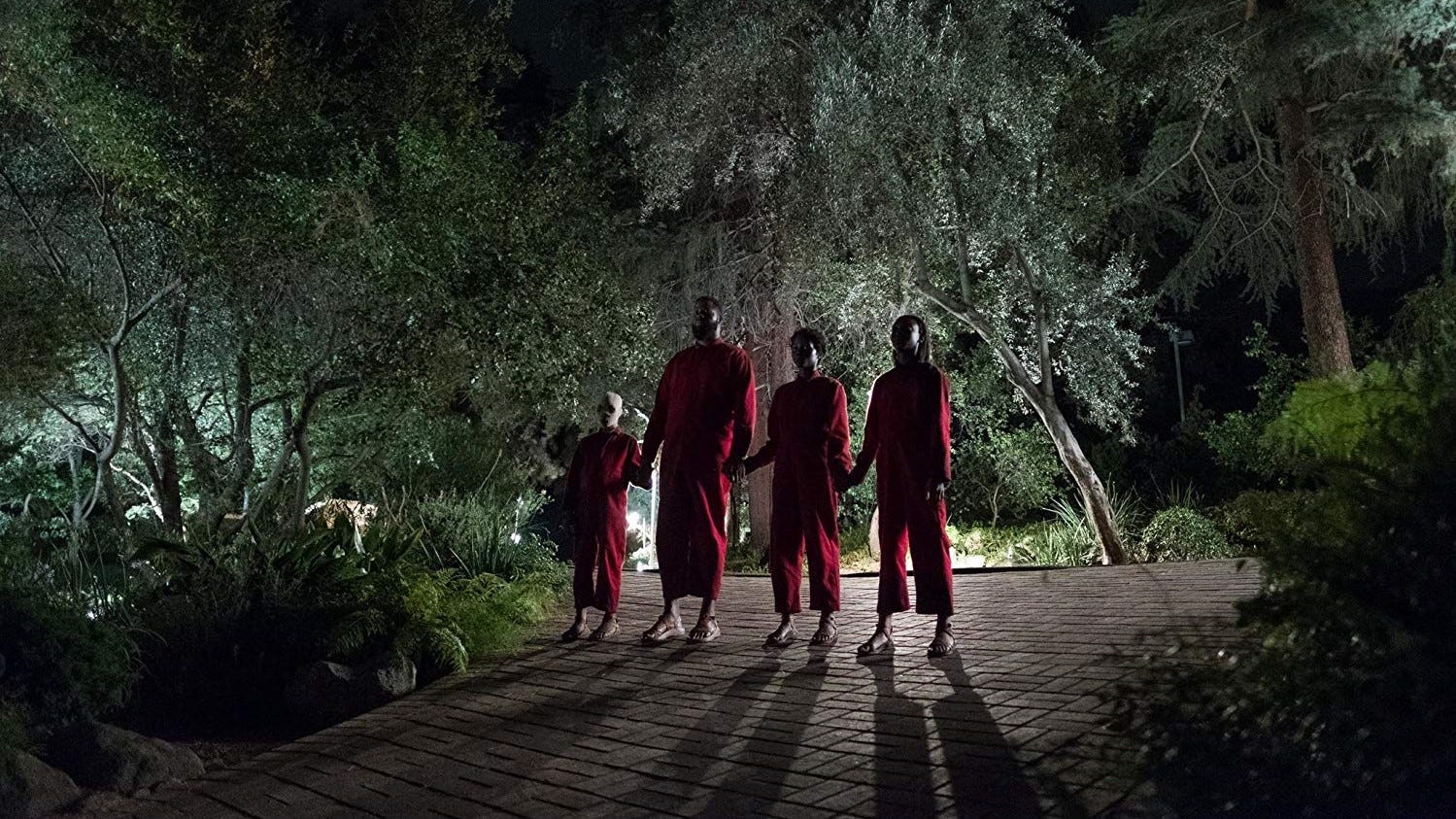
Although this movie doesn’t have nine different interpretations, it does seem to speak on the surface very heavily to the idea of revolution, just in Peele’s patently demented way. At the beginning of the movie, when Red is wandering away from her parents, she sees a young homeless man holding up a cardboard sign that says Jeremiah 11:11. This verse reads: “Behold, I will bring evil upon them, which they shall not be able to escape; and though they shall cry unto me, I will not hearken unto them.” Though this predates Red and Addy switching places, it is important enough to be a visual card on the movie’s opening along with the explanation (getting ahead of the naysayers) that there are countless abandoned tunnels under America.
Relativity and Disenfranchisement
Are people “good,” or are they privileged?
Are people “bad,” or are they victims?
We have a fever dream here in America that good and bad are solid particles that make up the human being, and the proportion of one to the other expresses itself in behaviors and outcomes that we deem consistent with that makeup. If you are made up of mostly good particles, we’ll be able to tell because you’ll be good-looking, in a relationship, own a home, have a steady job, and be financially secure. You are a “good” person.
If you are made up of mostly bad particles, you’ll look offensive in some way, have a history of broken relationships, live (rent) in a depressed area, hold a minimum wage job or stay on welfare, and have a legacy of poverty. You are a “bad” person.
See, the “good” particles forced the good person to be clean-living and have greater opportunities; it’s not the result of history or society or economy or politics. They just exist as “good.” Same for the “bad” person. And so, with this in mind, we feel completely justified and obligated to judge people based on the way we think they live, and the way they look, and where they come from, in order to keep persuading ourselves that the entirety of the universe is a known quantity and reality is completely apprehendable and of course we, we ourselves, are good people too.
Addy, though young, was a “good” person, which we can tell by her sweet face, stable family, and middle-class opportunities like the boardwalk in summer. When she was forcibly replaced and made to live in the tunnels, she grew to hate her very existence and vowed to wreak havoc on the world above in such a manner that the country would come to a standstill as blood was shed across the land.
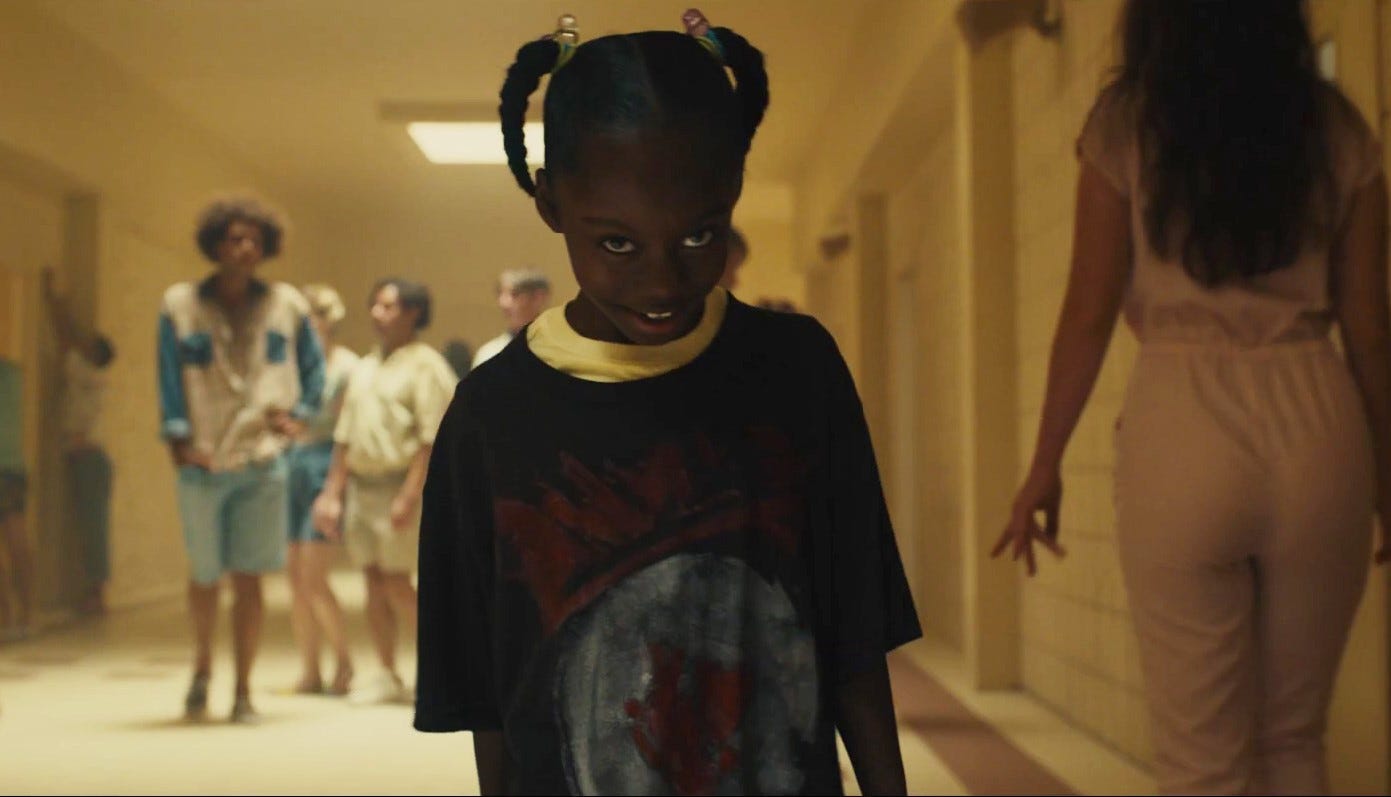
Red, though young, was a “bad” person which we can tell by her sullen features, barely existent family structure, extremely limited opportunities, and savage poverty (rabbit-only diet). When she escaped to the world above, she learned to speak, to dance, to love, she became educated and married and built a stable family with resources like a summer home.
If we were simply conveniently built of good and bad particles, the preceding two paragraphs would be impossible. You could not “become” better or worse with a change in your environment or circumstances—you simply are a good or bad person! Right?!
So obviously the point is that given the conditions, people can start off in great or terrible circumstances without it having anything to do with who they are as a person, or who they choose to be, although depending on the surrounding rhetoric it can seriously affect their belief that they have a choice in the matter.
What makes the concept (or, reality) of the disenfranchisement of black people in America so difficult for some to accept is this idea that the people we see today that we deem “bad” could be products of history and environment rather than sacks of blood and bile held together by magically negative particles. Some are much more comfortable believing that one is born bad, than coming to understand and accept that in the just right circumstances, they too could become what they fear; that being a good person is a constant, daily choice, and not one that can be signaled by which job you work or car you drive or country club you belong to. One of my favorite examples of this comes from the movie District 9, where protagonist Vikkus goes from being Good Guy to Homeless Thief in about three hours thanks to the alien hand growing out of his arm. Ladies and gentlemen, we are all one alien hand away from having to grab a giant pair of scissors and rise up.
And really, “good” and “bad” (or “evil”) are really just constructs we rely on to guide us through a world of other people with interests in contrast to ours. I’ll go out on a limb and say most people really are products of their environment without ever questioning the lineup of ingredients that were baked into them before they could walk or talk or reason. Most people really do believe they are inherently good, and that they can tell the scope of morality of another person by what is on the surface. And perhaps that’s Peele’s point too—the surface dwellers were normal, in control, “good,” but their actions hid a world beneath that was exposed as truly meaningless, even life-less, soul-less—the root of their existence was cold and cruel. And as long as they never had to face what suffered in the tunnels, they could believe the world was as it should be.
Savior and Spider
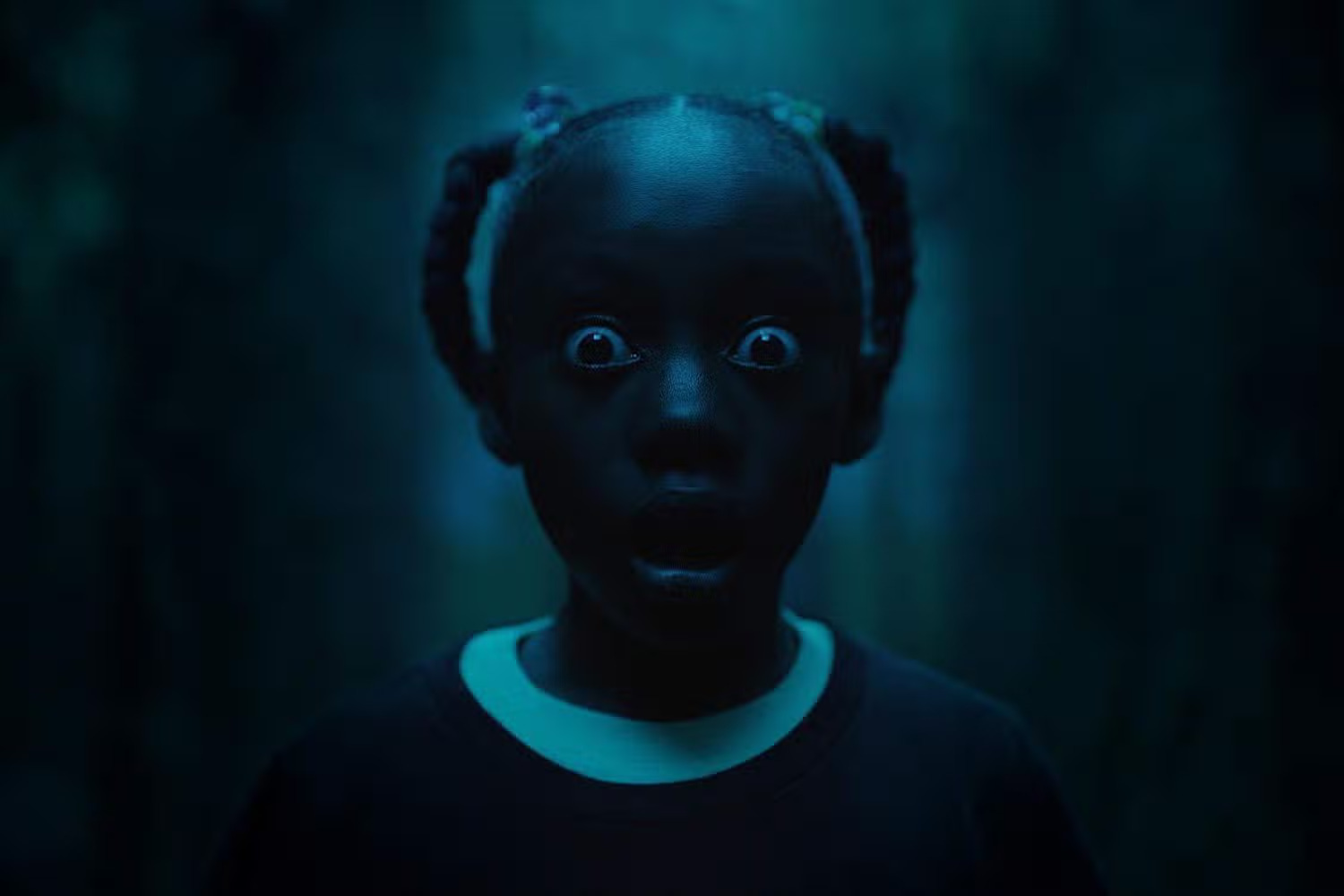
This is where Addy comes in. She serves as a catalyst for change because she knows both worlds and understands the injustice of the tethering. While upstairs Red was learning to dance in order to express herself, downstairs Addy was as well, and her fateful performance as the literally captivated audience watched showed them that they could be more than what they were. They saw her as a leader then—even a savior.
For, when she danced it was not just another pantomime; the movements weren’t uncoordinated and disconnected, she wasn’t pulled along by a string. She could choose even while her twin upstairs performed; she could pull herself together and make something beautiful. It was like nothing the replicas in the audience had ever seen or even contemplated before and it was a revelation, and it brought hope, and a chance at a new life. From that night, the Tethered followed Addy wherever she would lead.
In this vein you can see Addy as a Christ figure, delivering the Tethered from their misery. When they begin to “wake up,” they move more like the people above; their chaos is smoothed out; as Addy admits, “Everything had to be perfect.”
Because isn’t that how twin-souls Red and Addy lived already? When you compare them as little girls, they act startlingly similar. Red, from the tunnels, didn’t act tethered - she glided along, side-eyeing the craziness around her, seeing her world for what it was, total nonsense. We can chalk this up, I suppose, to her having a supernatural sense of her twin above and them being special in that way. But Red was looking for a way out, too. She didn’t belong there. She knew she could be free. How connected were the little girls, one must ask themselves? Why did Addy wander off that night on the boardwalk? Was it really just coincidence that she entered the hall of mirrors which contained the entrance to the tunnels? Did she already know?
On a repeated viewing I noticed that when Addy was in the hall of mirrors and the lights had gone out and she was afraid, her response was to begin whistling “The Itsy-Bitsy Spider.” This could be seen as a calming or coping mechanism, but I started to wonder: what if, just what if…she was whistling so that Red could find her?
There are several allusions to spiders and webs that are never fully fleshed out in the film. For example, after Red flashes back to the counseling session where her parents and therapist discuss her inability to talk, she sees a spider on the coffee table. If you had guessed at that point the girls had switched places, it was a meaningful spider, and what do spiders do? They spin webs. I started to wonder, who had spun a web, and for whom?
After Addy and Red’s vicious fight for their lives down in the tunnels, Red has Addy stabbed and cornered, and what does Addy do? She, very painfully, begins to whistle “The Itsy-Bitsy Spider.” This angers Red so much that she chokes the remaining life out of her twin. Why?
Was Addy in control the whole time??
Did she mean to go down and join the tethered, did she want to? Why? Did she sense their existence and become filled with glorious purpose? Could she control Red, was it backward?
When Addy is expositioning to Red in the classroom, she says, “I often wondered why you didn't take me with you” - why? Did she think they would meet and it would be positive, that they might work together? But instead, Red kidnapped and replaced her. When she whistled a last time, was that her way of saying that she had always been in control – Red’s choices were never her own, and perhaps Red knew this on a subconscious level, hence the blotting out of life?
Who’s tethered to whom?
This particular question, for me, is the crux of what makes the movie such an important statement on our divided world. We assume that the people in the tunnels are tethered to the people up in the real world, that they are being dragged along by the choices and mistakes made in the daylight, thus accounting for their cracked movements and lack of autonomy. We assume they are the puppets below the strings.
I say, imagine it is the world upstairs that is tethered to the world downstairs, and the people in the tunnels who are in control.
When Red begins to explain to Addy the nature and history of the tunnels, the world of the tethered is shown before the world of people above ground. We see Addy following behind her parents in the tunnels as her father stumbles forward and points awkwardly to his right, where the man with the distressed Thriller t-shirt awaits. Then we see them above ground at the carnival, where Red decides she wants the Thriller t-shirt. Their actions are very cleverly placed in this particular order, and if they were reversed, I wouldn’t have my theory.
What does it mean for the Tethered (I guess we still have to call them that) to be in control?
It means the actions of the world above ground are choiceless and dictated by the abnormal, restricted, and violent behavior of the people below. “Our” world is controlled, modeled after and justified by the long-insane behavior of the Tethered. The “real world” is the result of jerks and twitches and artifice. What we think is “normal” has its basis in abnormality; what we think is beautiful, smooth, easy, happy, is fundamentally ugly, jagged, difficult, and angry. When the father downstairs is punching a wall, the father upstairs is playing Whack-A-Mole. When the bleach-blond mom downstairs is cutting up her face for grins, the mom upstairs is getting light plastic surgery. We think of these things, carnival games and beautification, as unproblematic and even fun, but what do we think of them when we know their genesis? Does it change their nature, their value?
At the end of the day, do the Tethered want anything? Red says they were left alone, abandoned by the government that created them, and over generations became this monstrous force, but wouldn’t it be more like a force of nature? Inevitable, perhaps, and blind, and indifferent? The Tethered only know their world below, and not that there are like souls above them living strange conjoined lives. I would say the Tethered simply are; not out to hurt their counterparts but simply living, and any consequences are beyond their grasp. (That is, until Red unites them of course)
And think of the limitations of the space in which they “live.” When Addy does her dance, for example, she continues to run up against and push off the walls, lacking the generous space of the stage that Red occupies. Those walls serve to restrict the choices the Tethered make and the actions they can take—thus, being in control of the world upstairs, this restricts the behavior and opportunities of the people above as well. What would the Tethered do with more room? And what could their counterparts then accomplish? In what ways is the “normal” world bound and unable to truly run free because their motions all come from the same inhibited space?
Here we start to get more metaphorical. Is Peele saying that our world is really “controlled” by people like the Tethered, uninspired and violent and painfully limited, while those who live above—or are able to rise above—can only make the best of a bad situation, turning ugliness to beauty and anger to laughter? Who are the Tethered here then—politicians, corporations, the war machine? Even further, are they our false histories and what we only believe to be capable of; are they the demands of our culture, with its impenetrable boundaries safeguarding a mist that masquerades as truth? Do these various tetherings stocked deep in finite tunnels keep those of us willing to live and die for more bound by these limitations we know we can feel, we know are there, even though we can’t see them, even though we know without them we would fly?
The Others
There are other interpretations of the film I noticed that I’ll run through briefly:
Addy could be seen as a cult leader, with the enormous following she has, the tremendous impact she has made on their lives, and the way the Tethered faithfully follow instructions. (When they come up from the tunnels, each replica is only allowed to kill their own counterpart. Kitty’s replica has a chance to kill Red but she doesn’t—she has to leave her for Addy, which takes an enormous amount of will)
The link between the upstairs and downstairs world could represent the psyche and how we regulate ourselves in order to fit in, leaving the mess for the deeper realm and coating the surface with normality (until something breaks)
The swapping of Red with Addy could be the development of an alternate personality
The movie at its very end looks like a war movie, specifically Vietnam, with the vast rolling hills, helicopters hovering, smoke in the distance, and the long trails of blood—I mean, people in red jumpsuits—cutting across the landscape. What might Peele be saying here? When Red and her normal parents are at the therapist, the father rejects the idea that anything traumatic happened to her: “She wasn’t in ’Nam.” Is Us subtly about PTSD?
The therapist also urges the parents to get Red to “draw, to write, to dance,” anything that would help her tell her story, which sort of sounds like trying to get through to a child on the spectrum; and Red is mute like a child with no or late language development. Perhaps there’s something about growing up divergent within the movie’s web…
Normal?
The first way in which the world of the Tethered hit me was as a horrifying, spellbinding reproduction of what it feels like to be neurodivergent walking in a world of “normal” people. I must seem to have it backwards, right? Red was quiet, calm, if strange; it was those around her who jerked and spazzed and cackled as if malfunctioning as their base nature. But no, I said it right. I immediately identified with Red as she stared at the behavior around her, so far removed from it in body and mind and spirit, and the behavior itself, stylized for the screen, only emphasized the memory for me of what it had been like to learn to live in this world.
As a child, human behavior was a mystery to me, and even the typical day-to-day motions of laughing and whispering and crying, watering a plant or opening a book, were pantomimes that I could really only study in hopes of becoming more like those around me. (Still some days I feel like a machine with imperfect programming, still trying to get it right) At age six I even watched a kid blink to learn that it doesn’t need to happen in the regimented cadence I carefully adhered to. I saw kids squint their eyes in the bright sunlight and imitated them because my own eyes wouldn’t do it on instinct. All around me, people were doing things that were new or unnatural to me and I watched them, and I saw how they all were the same, and I was different.
That was Red walking through the tunnels as we saw her; everyone seemed to have gotten the memo but her, and what was strange to her was “normal” to the Tethered.
* * * *
Honestly, I think I might like Us just a little bit better than Get Out (though not as much as Peele’s grand opus Nope). Every time I watch it there are not only new things to consider, but the same aspects I’ve mulled over a hundred times are as thrilling as the first time. I absolutely adore the idea of the Tethered and how they are represented; it is true horror, though it doesn’t look like teens being terrorized in the woods, and that is what makes it so special. Who’s controlling whom? Is Peele even saying that our world already is the world of the Tethered, and our attempts at life are sick jokes compared to what real living could be? When the screen pans excruciatingly slowly out on the cages of rabbits, the title card ‘Us’ is splayed in red over them—is Peele telling us that we are the rabbits? We are just the collateral damage in the spinning wheels of forces greater than us? I could literally do this all day, and that is why if you haven’t seen this movie, you need to do so ASAP.
Oh, and the next time you do something strange, something out of the ordinary for yourself, when you catch yourself saying or doing that thing and you don’t know where it came from…just remember to ask yourself who is tethered to whom.
Chef’s kiss analysis, per usual🤌🏾
Wow, Peele's work is SO dense and "US" is no different. Thank you for unpacking it. I was listening to Macklemore's Hind's Hall right after reading and these lyrics resonated, "Who gets the right to defend and who gets the right of resistance / Has always been about dollars and the color of your pigment."
As you explain, "... we feel completely justified and obligated to judge people based on the way we think they live, and the way they look, and where they come from, in order to keep persuading ourselves that the entirety of the universe is a known quantity and reality is completely apprehendable and of course we, we ourselves, are good people too."
How many people are tethered to us in the choices we make and actions we take? It feels like Peele's tying our loss of collective morality to the advent of biblical ideologies of good and bad / good and evil.